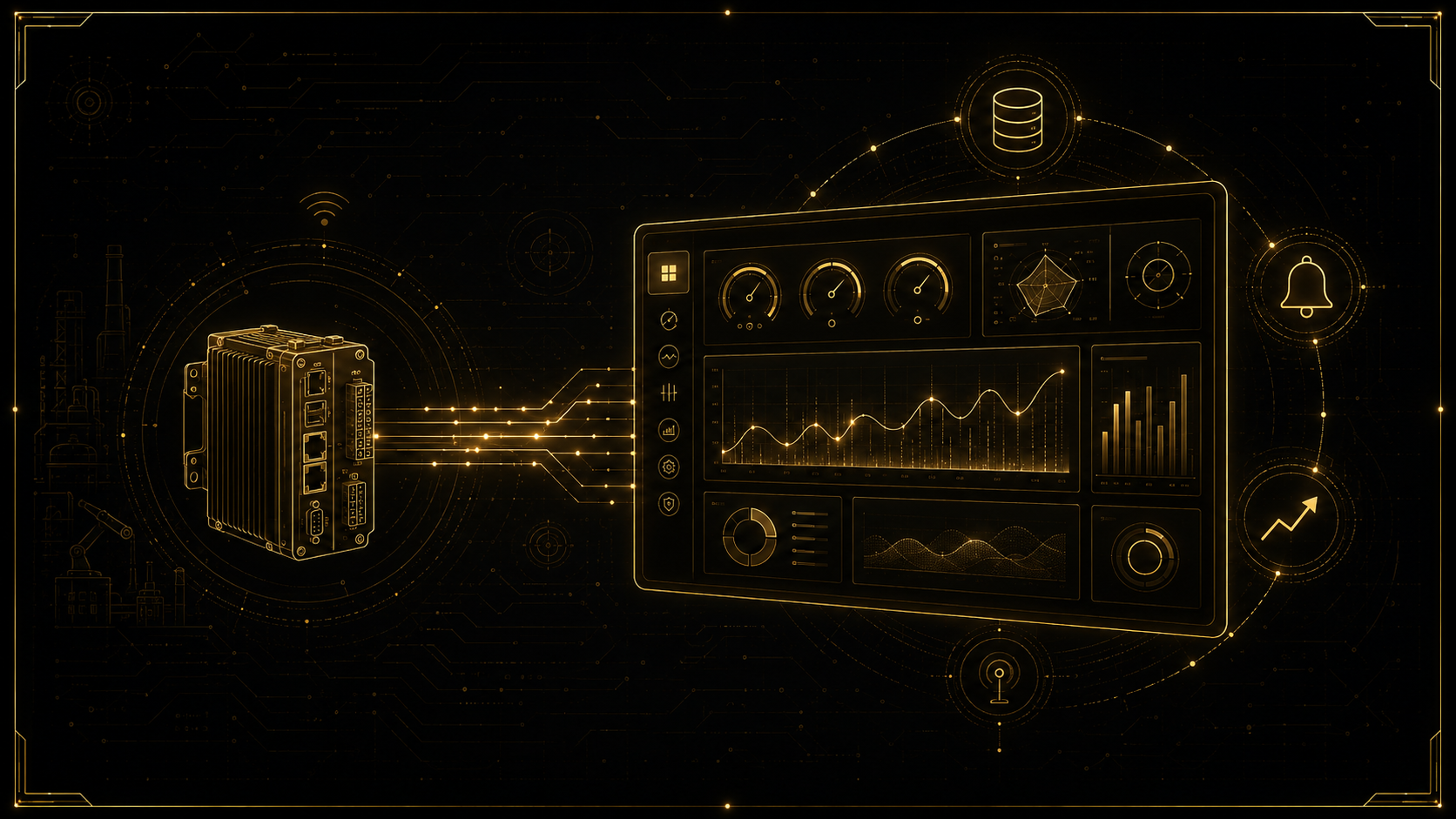
Connecting a machine with an embedded system is only half the story. The embedded device is the bridge — it reads signals and speaks to the network — but on its own it produces a stream of raw numbers. What transforms those numbers into a live picture of your factory, into remote control, into stored history and into early warnings before a breakdown, is the software that sits above it. In the systems I design, this software layer is where much of the real value is created, so it is worth understanding what it actually does.
What the software layer is
Think of it as three connected jobs, all running on top of the embedded hardware: acquire the data, use it (monitor and control), and learn from it (store and predict). Each of these is a distinct engineering discipline, and doing all three well — reliably, securely, and in a way that a plant operator can actually use — is what separates a demo from a system a factory depends on every day.
Acquiring the data
The first task is to bring the machine's data into software cleanly and reliably. This means speaking the machine's protocol (Modbus, OPC UA, MQTT, CAN and others), handling many devices at once, dealing with dropouts and reconnects, and time-stamping every value accurately. Good acquisition software never loses data: if the network hiccups, the embedded device or an edge gateway buffers the readings and forwards them once the link returns. That reliability is invisible when it works — and painfully obvious when it is missing.
Monitoring: turning data into a live picture
Once the data flows, it must become something a human can grasp at a glance. This is the world of dashboards, HMIs and SCADA-style screens:
- Live overview: the state of every machine on one screen — running, idle, in fault.
- Trends and gauges: temperature, current, speed and output shown as charts that reveal how the machine behaves over time.
- Drill-down: from a whole-plant view down to a single sensor on a single machine.
- Accessibility: the same picture available on a control-room wall, a desktop, or a phone in someone's pocket.
A well-designed monitoring interface answers a manager's real questions instantly: Is everything running? Where is the bottleneck? What changed?
Control: acting on the machine from software
Monitoring shows you what is happening; control lets you do something about it. From the software you can start and stop cycles, adjust setpoints, change recipes, or trigger an orderly shutdown — all sent safely down through the embedded device to the machine. The crucial word is safely: every command path is designed with permissions, confirmations and hardware interlocks so that software can improve the process but never put people or equipment at risk. Getting that balance right — powerful control with uncompromising safety — is one of the most demanding parts of this work.
Storing the data the right way
Data is only an asset if it is kept in a form you can actually use. Different needs call for different storage, and a good system usually combines several:
- Time-series databases: built for exactly this — millions of time-stamped readings, stored efficiently and queried fast for trends.
- Relational (SQL) databases: for structured records — production batches, orders, maintenance logs, operators.
- Edge storage: a local buffer on or near the machine so nothing is lost when connectivity drops.
- Cloud storage: for long-term history, access from anywhere, and heavy analytics across many sites.
Choosing the right mix — and structuring the data so it is searchable, exportable and ready for analysis — is a design decision that pays back for years. It is far cheaper to store data well from the start than to try to reconstruct it later.
From data to foresight: preventing future faults
This is where connected machines truly earn their keep. Stored data is not just a record of the past — it is the raw material for preventing the future's problems:
- Thresholds and rules: the simplest layer — alert when a value leaves its safe range.
- Trend analysis: spotting the slow drift that precedes a failure, such as a bearing gradually heating up or a motor drawing more current week by week.
- Anomaly detection: learning what "normal" looks like for a machine and flagging the unusual patterns a fixed threshold would miss.
- Predictive maintenance: using history and models to estimate when a part will fail, so it is serviced during planned downtime — not in the middle of production.
The result is a shift from reactive repair to proactive care: fewer surprises, less unplanned downtime, and equipment that lasts longer. This foresight is the single most valuable thing the software layer delivers, and it is only possible when acquisition, monitoring and storage were all built with it in mind.
Alerting and reporting
Insight is useless if it arrives too late or reaches the wrong person. A mature system pushes the right alert to the right people — on screen, by e-mail, or to a phone — with enough context to act. It also turns raw data into the reports a business runs on: output per shift, energy use, downtime causes, quality trends. Good reporting quietly turns the whole installation into a decision-making tool for management.
An architecture that scales and lasts
All of this has to hold up in the real world. That means an architecture that spans from the edge (fast, local, always available) to the cloud (scalable, global), that is secured end to end, and that keeps running when a network or server fails. It also means software that can grow from one machine to an entire plant without being rebuilt. Designing that architecture — so it is reliable today and still expandable in ten years — is where deep experience makes the difference between a system that ages gracefully and one that has to be replaced.
Why the software matters as much as the machine
A factory can have perfect hardware and still gain nothing if the software above it is fragile, confusing or blind to the future. Conversely, thoughtfully engineered software turns ordinary connected machines into a transparent, controllable, self-protecting operation. Bridging the two worlds — the embedded device that touches the machine and the software that gives it meaning — is precisely the work I specialise in, from the first sensor reading to the predictive model that prevents the next breakdown.
If you are looking for someone who can build this complete chain — connecting your machines, and delivering the software to monitor, control, store and predict — get in touch. I would be glad to discuss what your operation needs.