
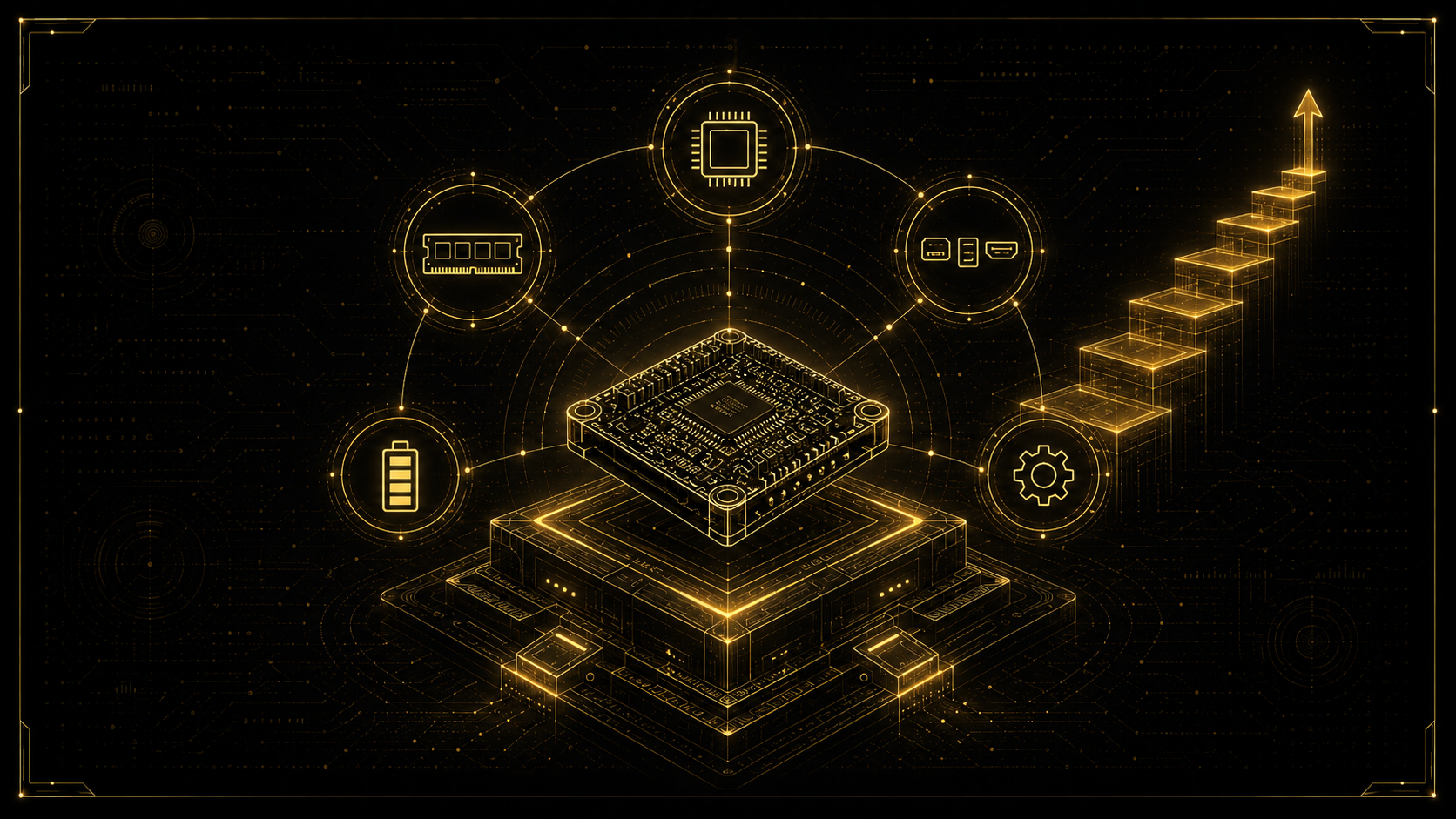
Every embedded project begins with a deceptively small decision: which microcontroller, and which platform around it? It feels like a technical detail to settle quickly and move on. In reality it is one of the most consequential choices you will make. That single decision shapes how much your product can do, how easily it can grow, how long it will stay buildable, and how free your hands are when — not if — the requirements change. This guide dissects the foundations of that choice so you can make it deliberately, with the future in mind.
Why this decision outlives every other
Code can be rewritten. A circuit board can be revised. But the platform you build your framework, drivers and habits around becomes the ground everything else stands on. Switching microcontroller families late in a project often means redoing firmware, re-validating hardware, retraining the team and rebuilding tooling. The cost of a poor early choice is not paid at the start — it is paid, with interest, every time you try to extend the product. Choosing well is really about protecting your future freedom to move.
Start with requirements, not with a chip
The most common mistake is falling in love with a specific chip first. The professional approach is the opposite: define what the system must do, then let that lead you to the platform. And crucially, define two sets of requirements:
- Today's requirements: what the product must do to ship.
- Tomorrow's requirements: the features you can already foresee wanting — more sensors, a display, wireless, encryption, more channels, a second product variant.
You do not have to build tomorrow's features now. But you must choose a platform that will not slam the door on them. A choice that fits today perfectly and cannot stretch at all is a trap.
The principle of headroom
The single most important idea in future-proof selection is headroom: never design at 100% of a chip's capacity. A microcontroller running at the edge of its flash, RAM, processing power or pin count on day one has nowhere to grow. As a rule of thumb, leave comfortable margin — often around 30–50% — in the resources most likely to be consumed by future features. Headroom is not waste; it is the space in which your product's next version will live.
Core technical selection criteria
With requirements in hand, weigh the platform against the dimensions that actually constrain growth:
- Processing: the core architecture (8/16/32-bit; ARM Cortex-M and RISC-V dominate modern designs), clock speed, and whether you need a floating-point unit or DSP features for maths-heavy work. A 32-bit core with room to spare rarely regrets itself.
- Memory: Flash (for code) and RAM (for data) are the resources features consume fastest. Choose generously, and prefer families that offer larger-memory variants you can step up to.
- Peripherals and connectivity: count the interfaces you need — UART, SPI, I²C, CAN, USB, Ethernet, ADC channels — then make sure there are spares. The interface you forgot is the one the next feature will demand.
- Power budget: for battery or energy-sensitive designs, low-power modes and efficiency can be as decisive as raw speed.
- Real-time behaviour: interrupt latency, timers and deterministic response matter enormously for control tasks.
The ecosystem and framework question
This is where a framework developer must look hardest, because the chip is only half of what you are adopting. Around every microcontroller sits an ecosystem, and that ecosystem determines how productive and portable your work will be:
- SDK, HAL and driver maturity: a well-designed hardware abstraction layer and reliable drivers save months and reduce bugs. Thin or buggy vendor software is a hidden tax on the whole project.
- RTOS and middleware support: if you may need multitasking, networking, a file system or a security stack, choose a platform with strong support for a real-time operating system and proven middleware.
- Framework and language fit: decide early whether you are building on bare-metal C/C++, a portable framework such as Zephyr, a vendor framework like ESP-IDF, or something higher-level. A portable framework can free you from any single vendor; a vendor framework can be faster to start but harder to leave.
- Tooling, documentation and community: a mature toolchain, good debugging support, clear documentation and an active community turn hard problems into solved ones. Sparse documentation quietly slows every future step.
A modest chip with an excellent ecosystem often beats a powerful chip with a poor one. You are not just choosing silicon — you are choosing the software world you will live in.
Designing for portability
The deepest form of future-proofing is not picking the "right" chip — it is architecting your software so the chip matters less. This is a framework mindset:
- Abstract the hardware: put a clean layer between your application logic and the specific microcontroller, so business logic does not directly touch registers.
- Isolate vendor-specific code: keep anything tied to one vendor in a small, replaceable corner.
- Prefer standards: standard interfaces, protocols and portable frameworks reduce lock-in.
- Choose scalable families: pick a microcontroller from a family with pin- and code-compatible siblings, so you can step up to a bigger device — more memory, more peripherals — without redesigning everything.
Done well, this means that if you must change the underlying chip in three years, you replace the abstraction layer, not the whole product.
Supply chain and lifecycle
A brilliant choice on paper is worthless if you cannot buy the part. Future-proofing includes the boring, decisive realities of availability:
- Longevity: favour parts with a long guaranteed production life, especially for industrial products expected to ship for a decade.
- Availability and second sources: can you actually get the chip in the quantities you will need, and is there an alternative if one supplier stumbles?
- Cost at scale: the price at one unit and at ten thousand units can be very different; design around the volume you actually expect.
Recent history has taught every hardware team that supply is not guaranteed. Choosing a widely available family with alternatives is itself a form of insurance.
The prototype-versus-production trap
A frequent and costly error is choosing a platform that is perfect for a quick prototype but wrong for a real product — or the reverse. A development board that gets you a demo in a weekend may not be certifiable, manufacturable or cost-effective at volume. Decide honestly which stage you are truly building for, and if you are heading to production, choose a platform that can carry you all the way rather than forcing a disruptive switch halfway.
Certification and compliance headroom
If your product will face regulatory requirements — safety, wireless, medical, automotive — the platform must be able to meet them. Some ecosystems provide pre-certified modules, safety-qualified components and security features that dramatically shorten the path to compliance. Ignoring this early can force an expensive redesign exactly when you are trying to launch.
A decision framework
Bring it together by answering, in order:
- What must the system do today, and what can I foresee wanting tomorrow?
- Which resources will future features consume, and do I have 30–50% headroom in each?
- Is the ecosystem — HAL, RTOS, tooling, docs, community — strong enough to keep me productive?
- Can I abstract the hardware so I am not locked to one vendor?
- Does the family offer bigger, compatible siblings to scale into?
- Will the part be available, affordable at my volume, and supported for the product's life?
- Can this platform carry me from prototype through production and certification?
Common mistakes
- Choosing the chip first and bending requirements to fit it.
- Designing at 100% capacity with no room to grow.
- Underrating the ecosystem and paying for it in every later feature.
- Hard-wiring vendor-specific code throughout the application.
- Ignoring supply and lifecycle until the part goes out of stock.
- Optimising for the prototype and rebuilding for production later.
The foundation you build on
Choosing a platform and microcontroller well is not about finding the most powerful part or the cheapest one. It is about protecting your freedom to grow: enough headroom, a strong ecosystem, a portable architecture, a healthy supply, and a clear path from first prototype to shipped product. Get this foundation right and every future step is open to you; get it wrong and you spend years fighting a decision made in an afternoon. This kind of architectural judgement — balancing today's needs against tomorrow's possibilities — is at the core of how I approach every embedded project.
If you are starting a project and want the platform and architecture chosen so your product can grow for years rather than boxing you in, get in touch — I would be glad to help you build on the right foundation.