EtherCAT is one of the fastest and most precise industrial communication technologies ever created — the protocol of choice when machines must be coordinated down to the microsecond, from robots and CNC machines to entire production lines. Yet its brilliance rests on a handful of ideas that, once you see them, feel almost obvious. This guide assumes you know nothing about EtherCAT. By the end, you will understand exactly how it achieves its remarkable speed, how every layer works — frames, clocks, state machines, mailboxes, safety — and how a real EtherCAT network is built. This is meant to be the most complete EtherCAT explanation you can read in one place.
What EtherCAT actually is
EtherCAT — Ethernet for Control Automation Technology — is a real-time industrial Ethernet protocol, originally developed by Beckhoff and now maintained as an open standard by the EtherCAT Technology Group. It uses ordinary Ethernet hardware and cabling, but changes how the data travels so that it becomes fast and deterministic enough for demanding motion control. In practical terms: EtherCAT lets one controller command hundreds of devices — drives, I/O modules, sensors — and update all of them within a fraction of a millisecond, every cycle, reliably.
Why ordinary Ethernet is not enough
Standard office Ethernet is fast, but it is not deterministic. Messages can be delayed by switches, collisions and network traffic, so you can never guarantee exactly when data arrives. For streaming a video that is fine; for synchronising the axes of a robot, a variable delay of even a few milliseconds is unacceptable. Industrial automation needs data that arrives on time, every single cycle, without exception. This requirement — hard real-time behaviour over Ethernet — is the problem EtherCAT was designed to solve.
The core idea: "processing on the fly"
This single concept is the heart of EtherCAT, and understanding it is understanding the whole protocol. In a normal network, a message is sent to a device, the device receives it, processes it, and sends a reply — repeated for every device, which is slow. EtherCAT does something radically different.
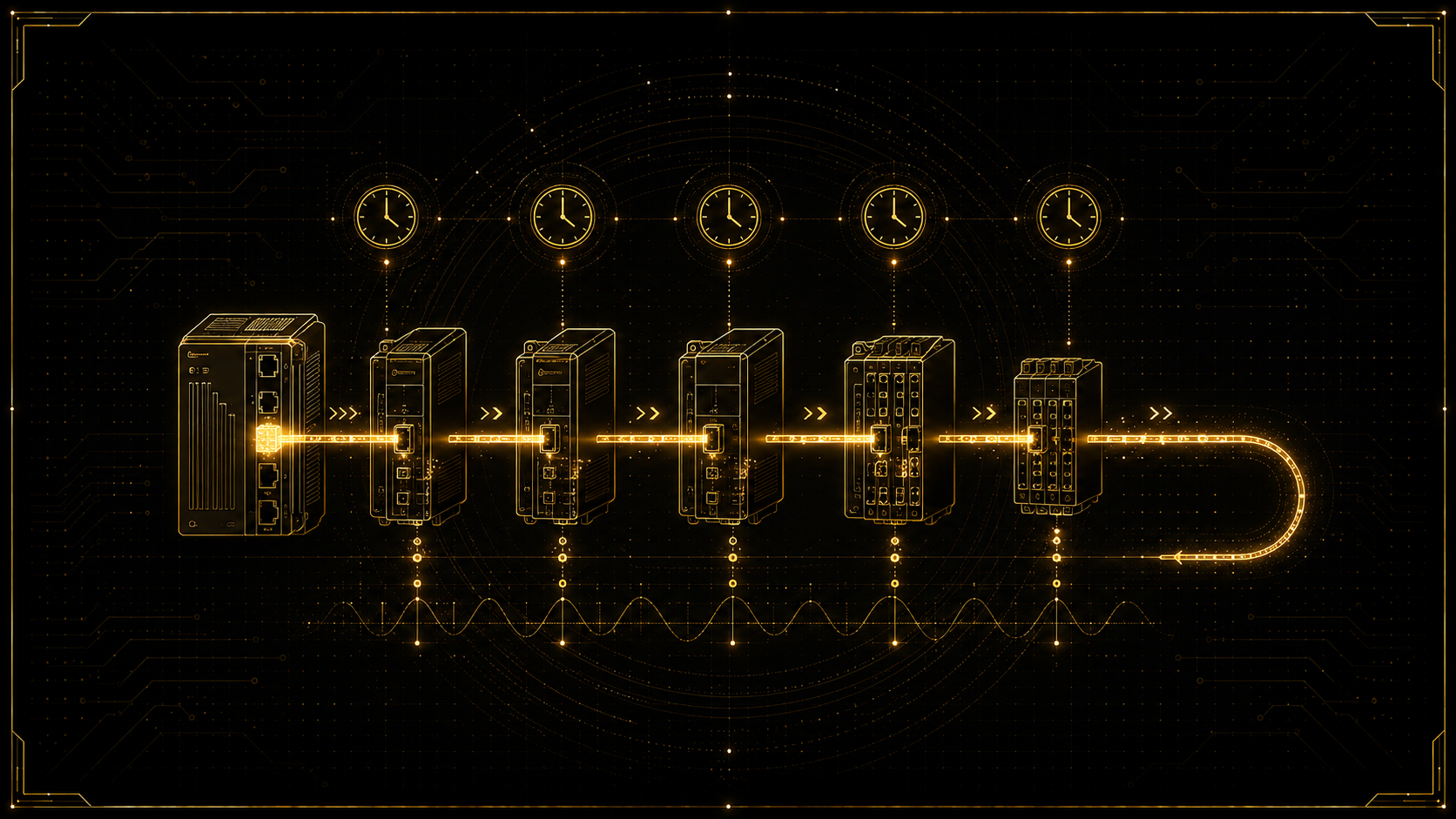
The master sends one Ethernet frame that passes through every device in turn. As the frame flows through each device, the device reads the data addressed to it and inserts its own data into the very same frame — all in hardware, in nanoseconds, without stopping the frame. The frame is never copied or held; it moves through each node like a train passing through stations, with passengers getting on and off while the train keeps moving. By the time the frame returns to the master, it has exchanged data with every device on the network in a single pass. This "processing on the fly" is why EtherCAT is so extraordinarily fast and efficient.
Masters and slaves
An EtherCAT network has exactly one master and many slaves:
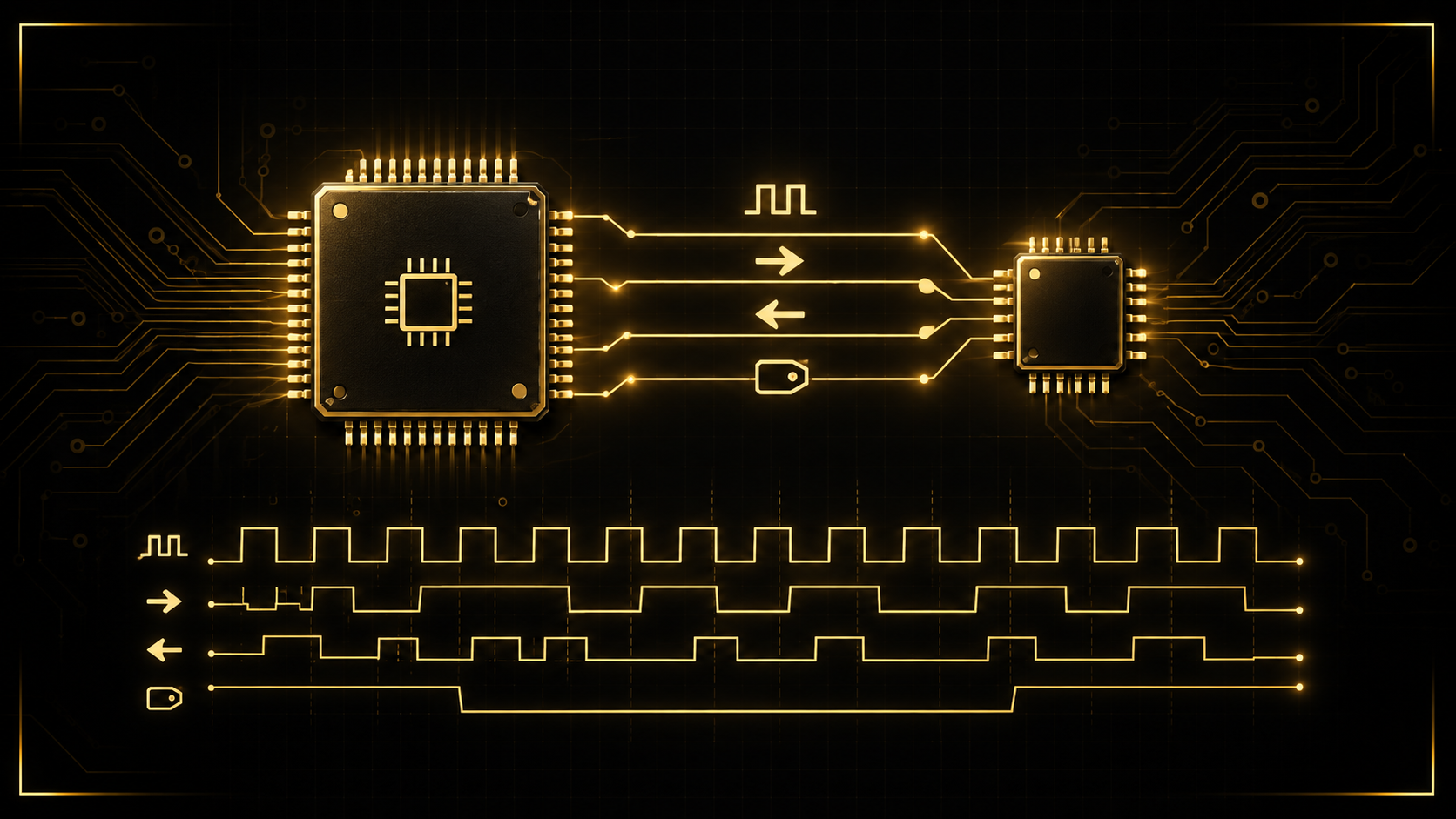
- The master is the controller — usually a PC or industrial controller running EtherCAT master software. It is the only device that initiates communication; it sends the frames and sets the pace. Importantly, the master needs only a standard Ethernet port, no special hardware.
- The slaves are the devices — servo drives, I/O terminals, sensors. Each contains an EtherCAT Slave Controller (ESC), a dedicated chip that does the "processing on the fly" in hardware, reading and inserting data as the frame passes with virtually no delay.
This asymmetry is deliberate: putting the intelligence and timing in one master, and cheap fast hardware in every slave, is what makes large, precise networks affordable.
Topology: one wire through everything
EtherCAT typically uses a line (daisy-chain) topology — the cable runs from the master to the first device, then to the next, and so on. Because each slave has (at least) two ports, the frame is passed along the chain and, at the last device, looped back through the same chain to return to the master. This forms a logical ring on simple line wiring. EtherCAT also supports tree, star and branch structures, and this flexibility, combined with the fact that it needs no switches, makes wiring a large machine simple and cheap.
Addressing: how each slave knows its data
Since one frame serves everyone, each slave must pick out exactly its own bytes. EtherCAT offers several addressing methods, the most important being:
- Position addressing: a device is identified by its physical position in the chain — useful during start-up.
- Node/configured addressing: the master assigns each slave a fixed address.
- Logical addressing: the powerful one — using a shared logical memory map (via FMMUs, Fieldbus Memory Management Units) so that a single command can read from and write to specific bits across many devices at once. This is what lets one compact frame efficiently service a whole network.
The magic of Distributed Clocks (DC)
Speed alone is not enough for motion control — the devices must also act at precisely the same instant. If two motors of a robot arm move even microseconds apart, the motion is wrong. EtherCAT solves this with Distributed Clocks: every slave has a local clock, and the network continuously synchronises them all to one reference clock. EtherCAT measures the tiny propagation delays between devices and compensates for them, achieving synchronisation typically well under one microsecond across the entire network. This means every drive can be told not just "move" but "move at exactly this nanosecond" — the foundation of perfectly coordinated motion.
Process data and mailbox: two kinds of communication
EtherCAT carries two very different kinds of data, and knowing the difference is key:
- Process Data (PDO): the fast, cyclic, real-time data — target positions, actual positions, I/O states — exchanged every single cycle with minimal overhead. This is the time-critical traffic.
- Mailbox (SDO and others): the slower, acyclic, on-demand data — configuration, parameters, diagnostics — sent when needed rather than every cycle.
The mailbox channel hosts several standard protocols layered on top of EtherCAT, so existing device models can be reused:
- CoE (CANopen over EtherCAT): by far the most common, bringing the mature CANopen device model to EtherCAT.
- SoE (Servo Drive Profile over EtherCAT): for servo drives following the SERCOS profile.
- FoE (File access over EtherCAT): for transferring files, such as firmware updates.
- EoE (Ethernet over EtherCAT): tunnelling standard Ethernet traffic through the network.
The EtherCAT State Machine (ESM)
Every slave follows a defined lifecycle called the EtherCAT State Machine, and the master walks each device through it at start-up:
- Init: the starting state; no communication except basic register access.
- Pre-Operational (Pre-Op): mailbox communication is active, so the master can configure the slave.
- Safe-Operational (Safe-Op): the slave sends its input process data but does not yet act on outputs.
- Operational (Op): full operation — both inputs and outputs are live and cyclic.
Understanding this sequence is essential in practice, because most start-up problems show up as a slave that refuses to reach the Operational state, and the state it stops at tells you where to look.
Synchronisation modes
How a slave times its actions relative to the network is set by its sync mode. The three common modes are Free Run (the slave runs on its own timing, loosely coupled), SM-Synchronous (the slave acts when new data arrives), and DC-Synchronous (the slave acts on a precise hardware interrupt from the Distributed Clock). For high-precision motion, DC-Synchronous is the mode that unlocks EtherCAT's full timing performance.
Diagnostics, reliability and redundancy
Industrial networks must not only run — they must be diagnosable and robust. EtherCAT includes rich diagnostics: each slave reports errors and working-counter mismatches, so the master can detect a broken cable or a missing device and often pinpoint exactly where in the chain the fault is. For high-availability systems, cable redundancy is supported: by connecting the end of the line back to a second port on the master, a single cable break can be tolerated without stopping the network — the frame simply reaches every device from the other direction.
Functional safety: Safety over EtherCAT (FSoE)
Many machines must meet strict safety standards — emergency stops, safe torque off, safe speeds. EtherCAT carries this too, through FSoE (Safety over EtherCAT), which sends safety-critical data over the same network with the integrity required for the highest safety levels. This "black channel" approach means the standard network transports safe and non-safe data together, simplifying wiring while meeting certification requirements — a major reason EtherCAT dominates in machine building.
Master and slave stacks: what you actually build with
You do not implement EtherCAT from scratch. On the master side, common choices include TwinCAT (Beckhoff's widely used environment), the open-source IgH EtherCAT Master for Linux, and SOEM (Simple Open EtherCAT Master) — a lightweight open-source master that even runs on microcontrollers. On the slave side, devices are built around an EtherCAT Slave Controller chip plus the vendor's Slave Stack Code. For learning and for embedded masters, SOEM is an excellent, approachable starting point.
Hands-on: the shape of an EtherCAT master with SOEM
A full EtherCAT application is large, but the essential flow of a master is clear and worth seeing. Using the open-source SOEM library in C, the core steps look like this:
#include "ethercat.h"

char IOmap[4096];

int main(void) {
    // 1) open the network interface the EtherCAT bus is connected to
    if (!ec_init("eth0")) return -1;

    // 2) find and configure all slaves on the bus
    if (ec_config_init(FALSE) > 0) {
        ec_config_map(&IOmap);       // build the shared process-image map
        ec_configdc();                // set up Distributed Clocks

        // 3) walk the state machine up to Operational
        ec_statecheck(0, EC_STATE_SAFE_OP, EC_TIMEOUTSTATE);
        ec_slave[0].state = EC_STATE_OPERATIONAL;
        ec_writestate(0);
        ec_statecheck(0, EC_STATE_OPERATIONAL, EC_TIMEOUTSTATE);

        // 4) the cyclic real-time loop: exchange process data every cycle
        while (running) {
            ec_send_processdata();
            ec_receive_processdata(EC_TIMEOUTRET);
            // read inputs from IOmap, write outputs into IOmap here
            osal_usleep(1000);        // e.g. a 1 ms cycle
        }
    }

    ec_close();
    return 0;
}
Even without every detail, the pattern reveals the whole protocol in miniature: open the port, discover and map the slaves, set up the distributed clocks, climb the state machine to Operational, then exchange process data in a tight cyclic loop. That loop, running every millisecond or faster, is where the real-time control actually happens.
How EtherCAT compares to other fieldbuses
Placed beside its peers, EtherCAT's strengths are clear. Classic fieldbuses such as Modbus or CANopen are robust but comparatively slow. Other industrial Ethernet protocols like PROFINET and EtherNet/IP are capable and widespread, but EtherCAT generally leads on raw cycle time, synchronisation precision and efficiency, because the "processing on the fly" principle avoids the overhead the others carry. Where the application demands the tightest timing — high-axis-count motion, fast I/O — EtherCAT is very often the answer.
Best practices and common pitfalls
- Respect the state machine: when a slave will not reach Operational, read which state it is stuck in — it names the problem.
- Use DC synchronisation for motion; free-run timing is not enough for coordinated axes.
- Mind cable direction and port order in the daisy chain — EtherCAT wiring is directional.
- Use a real-time capable master (a real-time OS or a dedicated controller); a non-real-time PC will jitter.
- Keep the process image lean — map only the data you actually need each cycle.
- Plan for diagnostics and redundancy in machines that cannot afford downtime.
Where to go from here
You now understand EtherCAT from its founding idea to its details: processing on the fly, masters and slaves, distributed clocks, addressing, the state machine, process data versus mailbox, synchronisation modes, diagnostics, redundancy and functional safety. The natural next steps are running a small network with SOEM or TwinCAT, bringing a servo drive up through the state machine, and enabling DC synchronisation to see microsecond-level coordination for yourself. Each builds directly on the foundation this guide has given you.
EtherCAT is simple in principle and deep in practice — and designing precise, real-time, safe machine networks with it is exactly the kind of engineering I do. If you are building a motion-control system, a machine, or any application that needs deterministic real-time communication, get in touch — I would be glad to help you build it properly.