Industrial IoT — IIoT — is the discipline of connecting machines, sensors and processes so that a physical operation becomes a stream of data you can see, understand, and act on. It is the engine of Industry 4.0, and it sits at the exact intersection of everything I do: hardware, firmware, connectivity, security and software. This is the flagship guide in this series, and it is deliberately complete. If you know nothing about IIoT, by the end you will understand the entire stack — layer by layer — and you will have built a real, connected industrial node with your own hands. If you already work in the field, this is the map I use to think about every project.
What Industrial IoT really is (and how it differs from consumer IoT)
Consumer IoT is a smart bulb or a fitness band. Industrial IoT is a production line, a water network, a fleet of motors — and the stakes are entirely different. In IIoT, a lost message can mean a ruined batch; a security breach can stop a factory; a device must survive heat, vibration, dust and years of continuous operation. IIoT therefore demands what consumer IoT can be relaxed about: reliability, real-time behaviour, deterministic control, industrial-grade hardware, and security that is designed in, not added later. Everything below is shaped by that difference.
Why IIoT matters: the business case
IIoT is not technology for its own sake — it exists to create measurable value:
- Predictive maintenance: fixing a machine just before it fails, instead of after — the single biggest source of saved cost.
- Overall Equipment Effectiveness (OEE): measuring and improving availability, performance and quality with real numbers.
- Energy efficiency: seeing exactly where power is consumed and cutting waste.
- Quality and traceability: knowing precisely what each machine did to each product.
- Remote operation: monitoring and controlling assets without being on site.
Every technical decision in an IIoT project should trace back to one of these outcomes. Technology that does not serve a business result is just cost.
The IIoT reference architecture: five layers
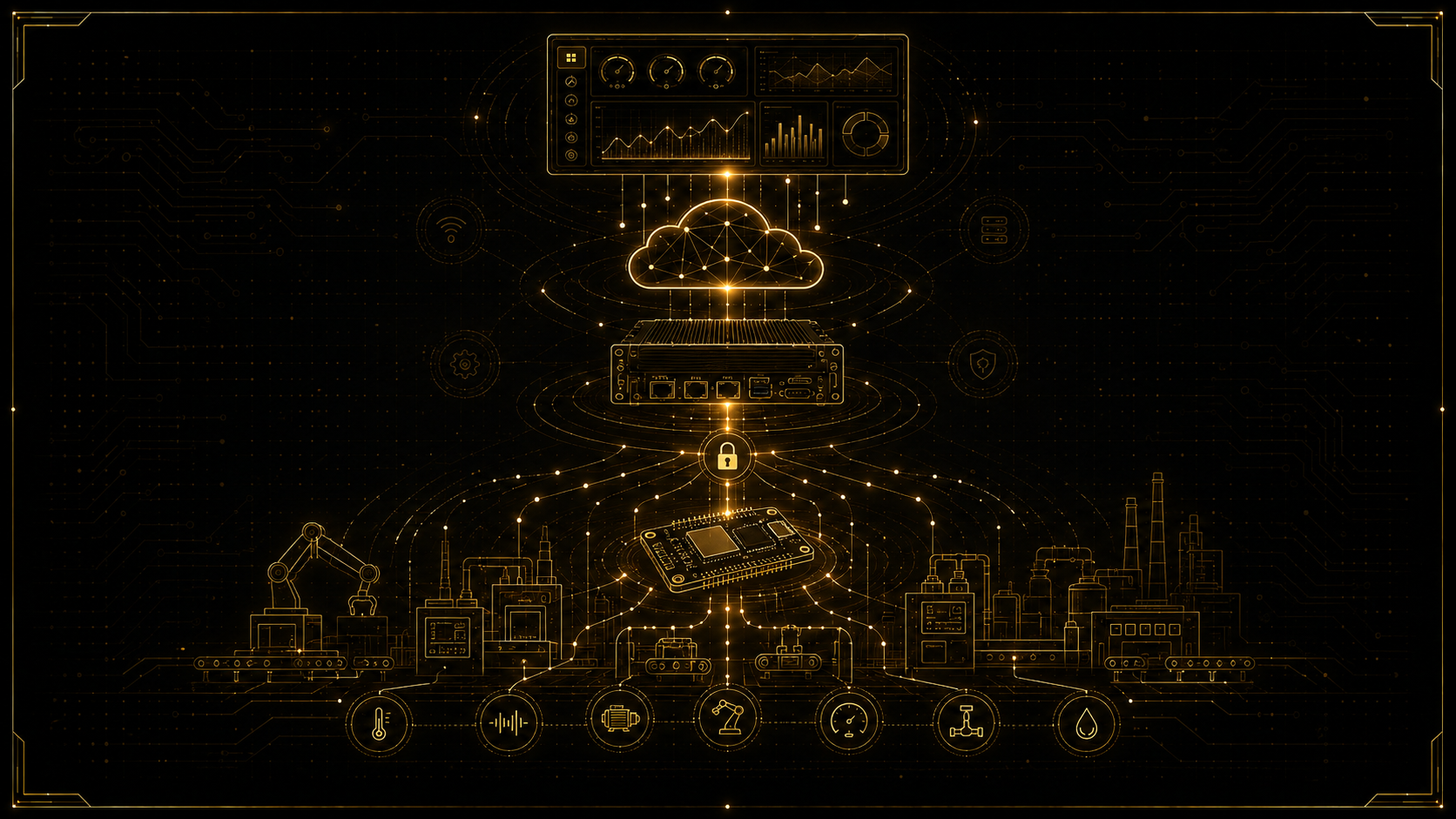
Almost every IIoT system, however large, is built from the same five layers. Understanding them is understanding IIoT:
- 1. The device / field layer — sensors, actuators and the microcontrollers that read them.
- 2. The connectivity layer — the protocols and networks that carry data off the machine.
- 3. The edge layer — local computing that filters, buffers and decides close to the source.
- 4. The platform / data layer — where data is ingested, stored and organised.
- 5. The application layer — analytics, dashboards, predictive models and control.
Let us walk up the stack, one layer at a time.
Layer 1 — The device layer: sensors, actuators and the ESP series
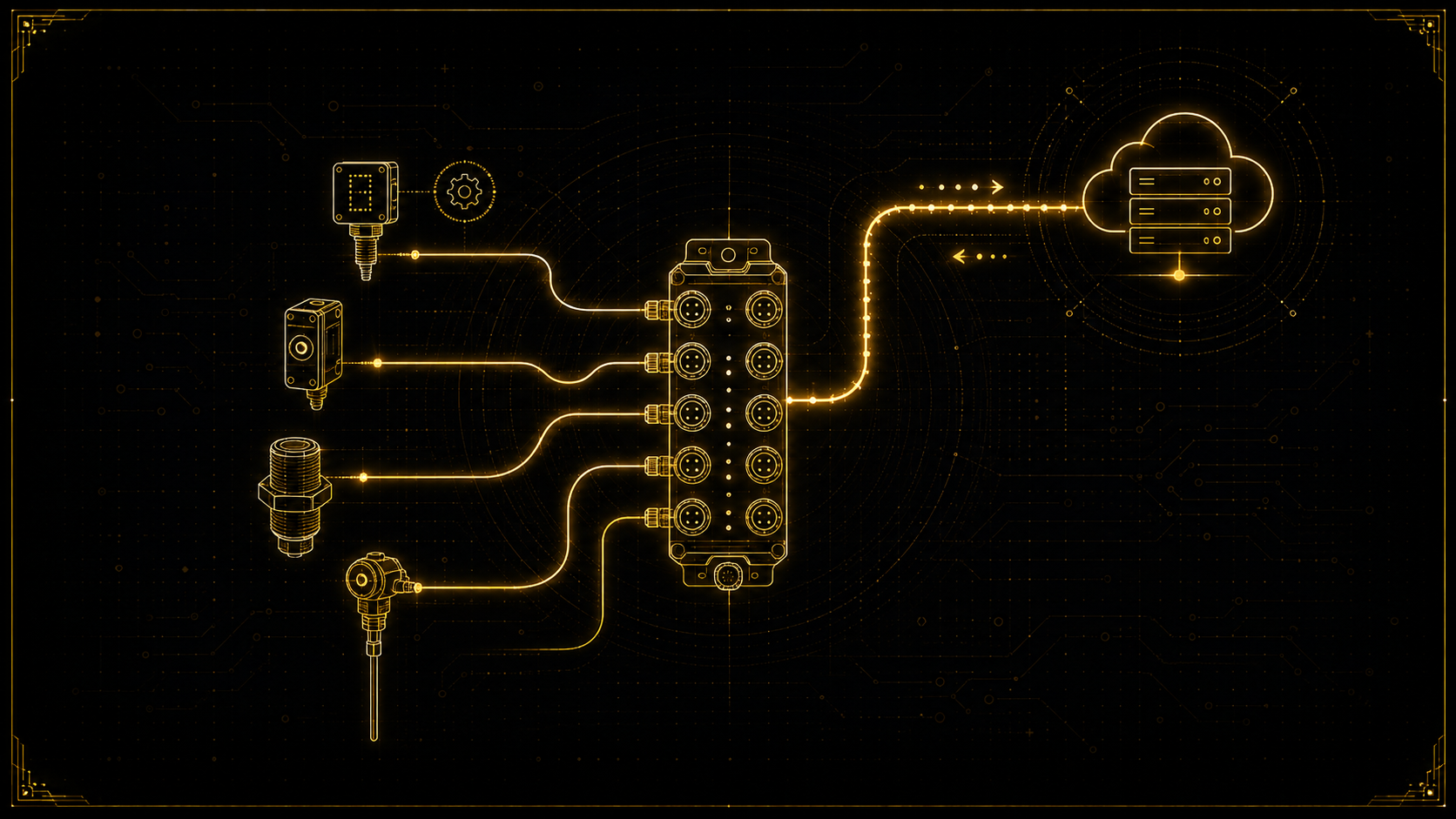
Everything begins at the machine. Sensors turn physical reality — temperature, vibration, current, pressure, position — into electrical signals. Actuators do the reverse, letting the system act. Between them sits the microcontroller that reads the sensors, applies logic, and speaks to the network.
For countless IIoT nodes, the ESP series from Espressif — the ESP32 and its smaller sibling the ESP8266 — has become a default choice, and for good reason: integrated Wi-Fi and Bluetooth, plenty of processing power, a rich set of interfaces (ADC, SPI, I²C, UART, CAN), low cost, and a mature software ecosystem (Arduino and the professional ESP-IDF framework). An ESP32 can read industrial sensors, run TLS encryption, buffer data, and publish over MQTT — a complete IIoT node on a single low-cost module. It is the device I reach for constantly to turn an idea into a connected prototype quickly, and it scales cleanly toward production. In harsher or safety-critical settings it is paired with industrial-grade MCUs and proper signal conditioning, but the ESP series remains one of the most productive on-ramps into IIoT that exists.
Layer 2 — Connectivity: getting data off the machine
A sensor value is worthless until it reaches your system. The connectivity layer is where the protocols I have covered elsewhere in this series come together:
- Fieldbuses like Modbus, CAN and PROFIBUS read data directly from existing machines and PLCs.
- MQTT carries telemetry efficiently to a broker and on to the cloud — the messaging backbone of IIoT.
- OPC UA provides secure, self-describing, vendor-neutral data exchange — the interoperability standard of Industry 4.0.
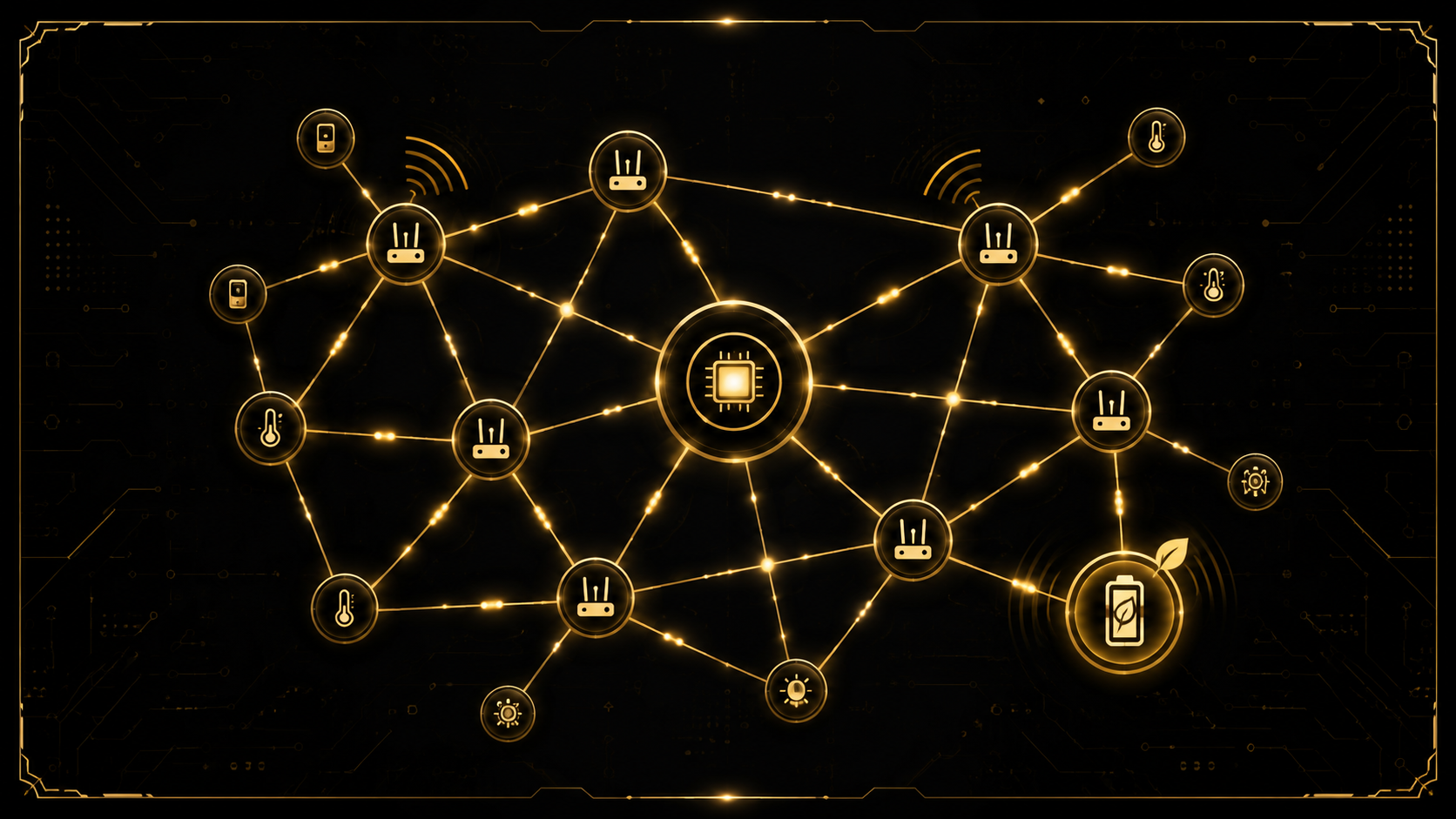
- Wireless — Wi-Fi, cellular (LTE-M/NB-IoT/5G) and LoRaWAN — connects assets where cabling is impractical.
Choosing the right protocol for each link — by distance, data rate, real-time need and environment — is one of the most consequential decisions in the whole system, and it is where deep protocol knowledge pays off directly.
Layer 3 — The edge: computing close to the machine
Sending every raw reading to the cloud is slow, expensive and fragile. Edge computing puts processing near the source: an edge device or gateway filters noise, aggregates data, runs local rules, and can even make instant decisions — stopping a machine on a dangerous reading without waiting for a round trip to a server. The edge also buffers data during a network outage so nothing is lost. Deciding what happens at the edge versus in the cloud is a defining part of good IIoT design: latency-critical and safety-critical logic belongs at the edge; heavy analytics and long-term storage belong above it.
Layer 4 — The platform and data layer
Once data arrives, it must be handled properly to have any value:
- Ingestion: reliably receiving data from thousands of devices at once.
- Time-series databases: purpose-built to store millions of time-stamped readings and query them fast.
- Relational storage: for structured context — batches, orders, maintenance records.
- Data modelling: giving every value clear meaning, units and relationships (exactly what OPC UA encourages).
Data that is stored carelessly becomes an unusable swamp; data that is structured deliberately becomes the foundation for everything above it. This design decision pays back for years.
Layer 5 — Analytics, digital twin and value
This is where data becomes money. On top of a good data foundation you build:
- Dashboards that give operators and managers a live, honest picture of the operation.
- Rules and alerts that flag problems the moment they appear.
- Predictive maintenance that learns each machine's normal behaviour and warns of failure before it happens.
- Digital twins — living virtual models of a machine or line, fed by real data, used to simulate, optimise and predict.
These are the outcomes that justify the entire investment — and they are only possible because every layer beneath was built with them in mind.
Security: the non-negotiable layer
In IIoT, security is not a feature — it is a requirement that runs through every layer. A connected factory is a target, and the consequences of a breach are physical. A serious IIoT deployment uses encrypted, mutually authenticated communication (TLS, certificates), a hardware root of trust and secure boot on devices, signed firmware updates, network segmentation following the IEC 62443 zones-and-conduits model, and a zero-trust posture where no device is trusted by default. Security designed in from the first sketch is what separates a professional IIoT system from a liability. (I have written a full, dedicated guide to embedded communication security in this series — it is worth reading alongside this one.)
Interoperability and standards
An IIoT system is never one vendor's island. Machines, sensors and software from many makers must work together, today and in ten years. This is why open standards — OPC UA and its companion specifications, MQTT, and frameworks like IEC 62443 — matter so much. Designing for interoperability from the start protects the entire investment against lock-in and obsolescence.
Hands-on: build a complete IIoT node with an ESP32
Theory becomes real when you build. Here is a genuine IIoT node: an ESP32 reads temperature and humidity from a sensor and publishes them as a JSON message over MQTT — exactly the pattern used in real deployments (in production you would run this over TLS to a secured broker on port 8883).
#include <WiFi.h>
#include <PubSubClient.h>
#include <DHT.h>

#define DHTPIN 4
#define DHTTYPE DHT22
DHT dht(DHTPIN, DHTTYPE);

WiFiClient espClient;
PubSubClient mqtt(espClient);

void setup() {
  Serial.begin(115200);
  dht.begin();

  WiFi.begin("your-wifi-name", "your-wifi-password");
  while (WiFi.status() != WL_CONNECTED) delay(500);

  mqtt.setServer("192.168.1.10", 1883);   // your broker (8883 for TLS)
}

void loop() {
  if (!mqtt.connected()) {
    mqtt.connect("esp32-line1-sensor");    // unique client id
  }
  mqtt.loop();

  float temperature = dht.readTemperature();
  float humidity    = dht.readHumidity();

  char payload[80];
  snprintf(payload, sizeof(payload),
           "{\"temp\":%.1f,\"hum\":%.1f}", temperature, humidity);

  mqtt.publish("factory/line1/environment", payload);
  Serial.println(payload);
  delay(5000);
}
The rest of the pipeline follows directly from the other guides in this series: the broker routes the message, a small backend service (for example the Python MQTT subscriber I showed earlier) receives it and writes it to a time-series database, and a dashboard displays it live — with alerts and trend analysis on top. That is a full, end-to-end Industrial IoT system, and you have just built its most important node. From here, adding more sensors, TLS, and a proper platform is a matter of scale, not new concepts.
Scaling from one node to a fleet
One connected node is a demo; a thousand is a system — and the jump between them is where engineering maturity shows. Scaling well means unique identities and certificates for every device, over-the-air firmware updates so a fleet can be maintained remotely, a broker and platform that handle thousands of connections, consistent topic and data models so every device speaks the same language, and monitoring of the devices themselves. Designing for that scale from the beginning — even while building the first node — is exactly the difference between a prototype that impresses and a platform that runs a business.
From experience, not just theory
For me, Industrial IoT is not an abstract subject. Among my registered patents are a programmable multi-plug for optimising intelligent power consumption and an intelligent water and electricity meter — both are, at their core, Industrial-IoT devices: they sense the physical world, they act on it, and they turn a physical process into actionable data. I have designed the hardware, written the firmware, chosen the protocols and thought through the security of connected systems end to end. That is the perspective behind this guide: every layer described here is one I have actually built.
Best practices and common mistakes
- Start from the business outcome — never connect things without knowing what decision the data will drive.
- Design the data model and topic structure early; they are painful to change later.
- Decide edge-versus-cloud deliberately for each function.
- Build security in from the first sketch — never as an afterthought.
- Plan for scale and updates before shipping the first device.
- Choose open standards to protect against lock-in.
- Never lose data silently — buffer at the edge through outages.
The future of IIoT
The field is accelerating. 5G brings low-latency wireless suitable for real-time control; edge AI puts machine-learning models directly on devices so they can detect anomalies locally; and digital twins are growing from dashboards into full simulations that predict and optimise entire plants. The layered architecture in this guide is exactly the foundation these advances build upon — which is why understanding it deeply is such a durable investment.
Where to go from here
You now hold the complete map of Industrial IoT: the five layers, the protocols that connect them, the security that protects them, and a real ESP32 node you can build today. The natural next steps are securing your node with TLS, adding a time-series database and dashboard, connecting a real machine over Modbus or OPC UA, and layering predictive analytics on top. Each builds directly on what you now understand.
Industrial IoT rewards engineers who can hold the whole stack in their head at once — hardware, firmware, connectivity, security and software — and make them work together reliably at scale. That is precisely the work I do, and the perspective behind every article in this series. If you are building an Industrial IoT system, connecting existing machines, or turning an idea into a connected product, get in touch — I would be glad to help you build it properly, from the first sensor to the full platform.