Every connected machine, sensor and controller depends on one thing to be useful: a way to talk. The communication protocol is the single decision that determines whether your data arrives reliably, in real time, and safely — or whether your project becomes a source of constant frustration. For embedded systems, and especially when connecting older industrial equipment, choosing the right protocol is not a detail. It is the foundation. This guide walks through every layer, from the copper wire up to the cloud, and then shows the proven ways to make a legacy machine speak.
Think in three layers
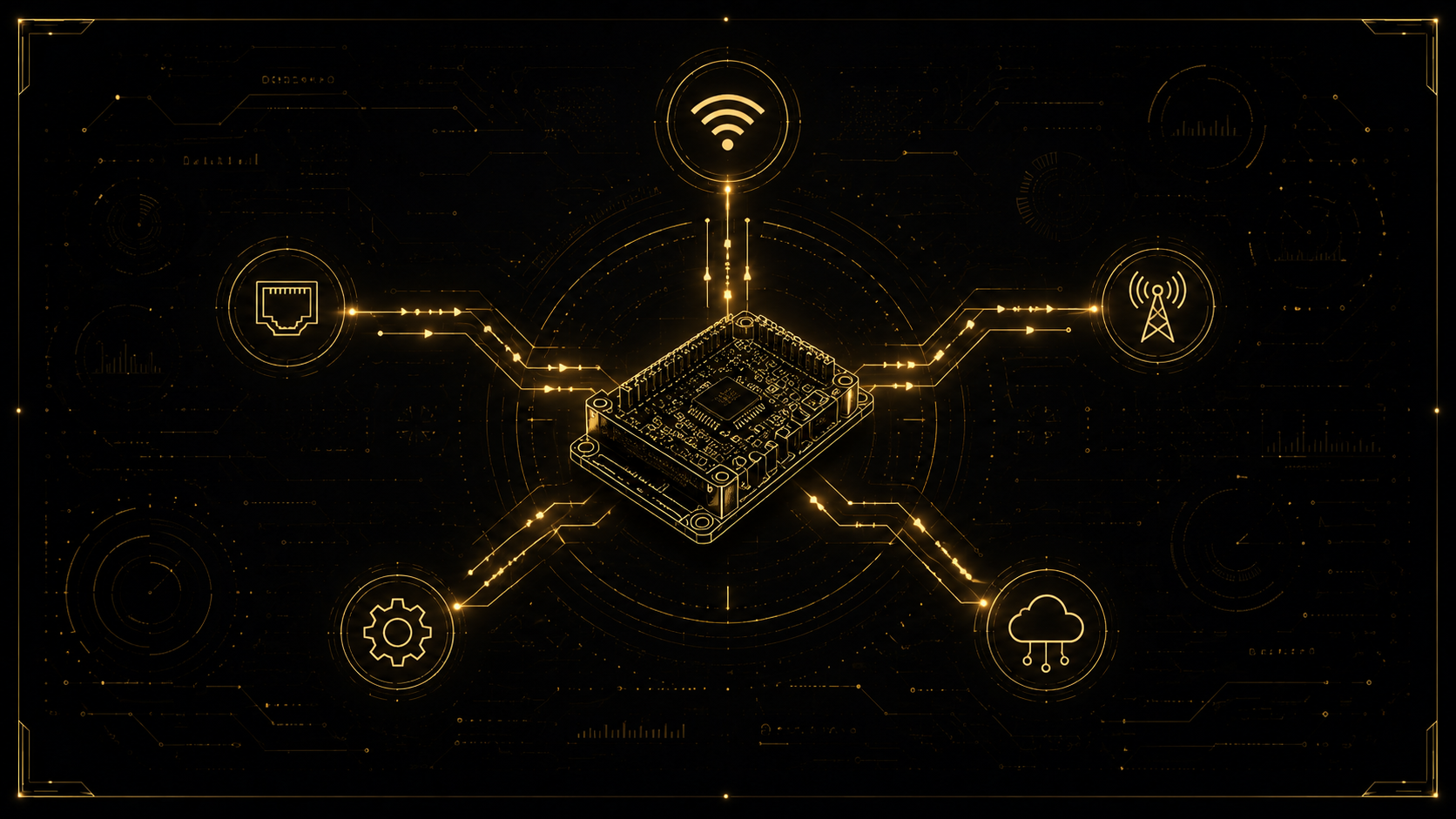
Communication is easiest to understand as a stack of three questions:
- Physical layer — how are the bits physically carried? (a wire, a radio wave)
- Fieldbus / transport layer — how are devices addressed and how do they share the medium? (Modbus, CAN, Ethernet)
- Application layer — how is the meaning of the data structured? (MQTT, OPC UA, REST)
A complete solution always answers all three. Mixing the wrong choices at different layers is the most common cause of unreliable systems.
Wired serial foundations
Most industrial communication still rests on a few rugged serial standards:
- UART — the simplest point-to-point serial link between two chips, the basis of much of what follows.
- RS-232 — the classic short-range serial port; still found on older equipment and service consoles.
- RS-485 — the workhorse of the factory floor: differential signalling that runs reliably over long distances and heavy electrical noise, and allows many devices on one pair of wires. If a legacy machine offers any digital communication, it is often RS-485.
Industrial fieldbuses
On top of the physical wiring sit the protocols that actually move machine data:
- Modbus (RTU & TCP): simple, open and everywhere. Modbus RTU runs over RS-485; Modbus TCP runs over Ethernet. Because it is so widely supported, it is usually the first thing to try when connecting existing equipment.
- CAN & CANopen: extremely robust, designed for vehicles and machinery where reliability is non-negotiable. Common in mobile equipment, drives and motion control.
- PROFIBUS: a long-established fieldbus in European automation, frequent on older Siemens-based lines.
- PROFINET, EtherNet/IP, EtherCAT: modern industrial Ethernet protocols for high-speed, deterministic control on newer machines and where precise timing matters.
| Protocol | Typical medium | Best for |
|---|---|---|
| Modbus RTU | RS-485 | Simple, low-cost connection to existing meters & PLCs |
| Modbus TCP | Ethernet | Networked devices with a spare port |
| CANopen | CAN bus | Robust motion, drives, mobile machines |
| PROFINET / EtherCAT | Industrial Ethernet | Fast, deterministic modern automation |
Wireless options
When cabling is impractical, wireless opens new possibilities — each with a clear sweet spot:
- Wi-Fi: high bandwidth inside a building with good coverage; convenient but needs a solid network.
- Bluetooth / BLE: short-range, low-power, ideal for local sensors and commissioning by phone.
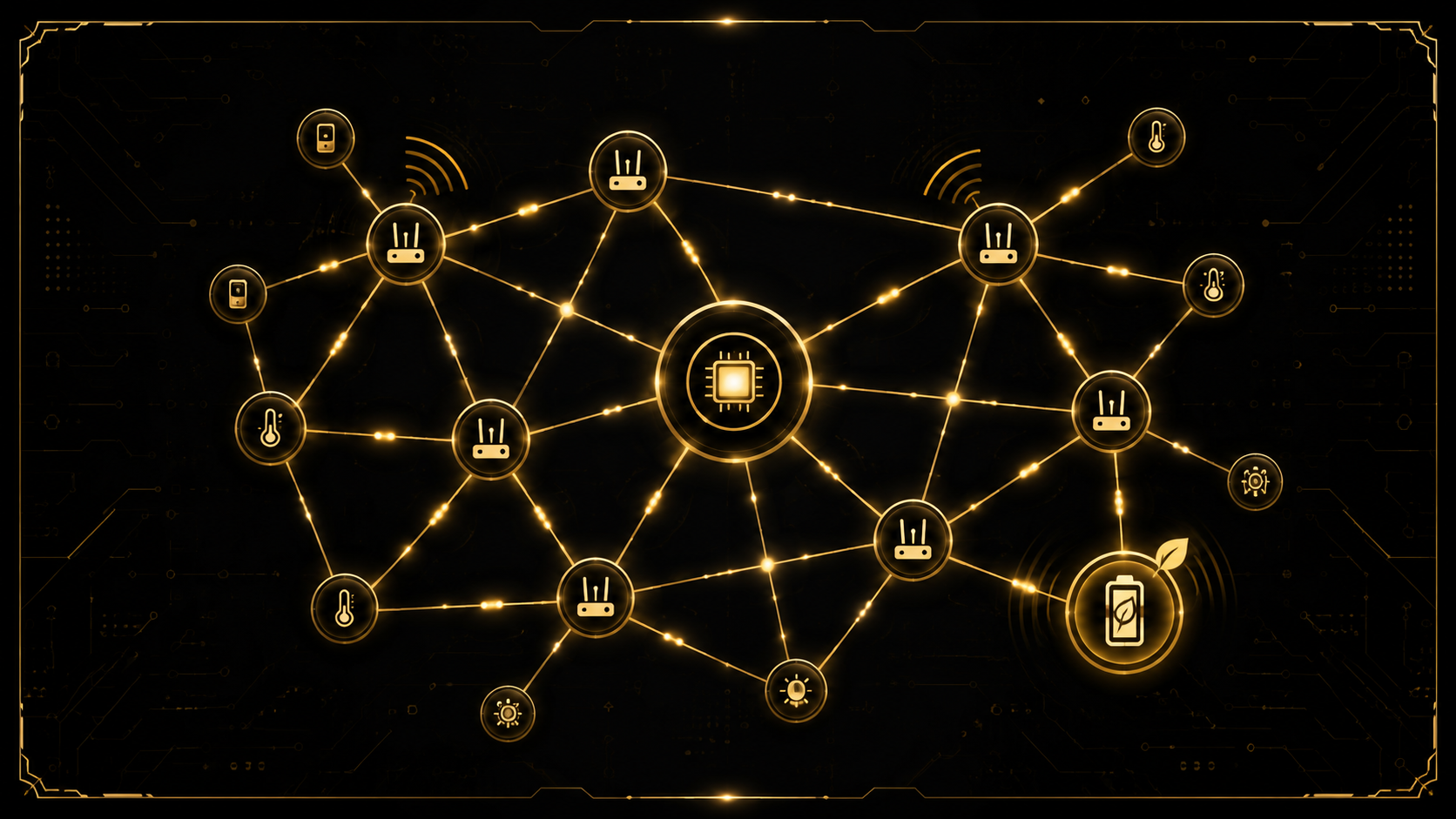
- Zigbee / Thread: low-power mesh for many small sensors across a site.
- LoRa / LoRaWAN: very long range with tiny data rates — perfect for battery sensors spread over a large plant or campus.
- Cellular (LTE-M, NB-IoT, 5G): connect equipment anywhere with mobile coverage, with no dependence on local IT — ideal for remote or mobile assets.
The IoT application layer
Once the bytes can move, they need meaning and a path to your software:
- MQTT: the lightweight publish/subscribe standard of IoT — efficient, scalable, and excellent over unreliable links. The default choice for sending telemetry to a server or cloud.
- OPC UA: the industrial interoperability standard. It carries not just values but their structure and meaning, with built-in security — the modern bridge between the factory floor and IT systems.
- HTTP / REST: familiar and easy to integrate with web dashboards and APIs, best where real-time demands are modest.
- CoAP: a compact, HTTP-like protocol for very constrained devices.
The hard part: talking to a legacy machine
Old machines rarely offer a clean modern interface. The art of a retrofit is meeting the machine where it is:
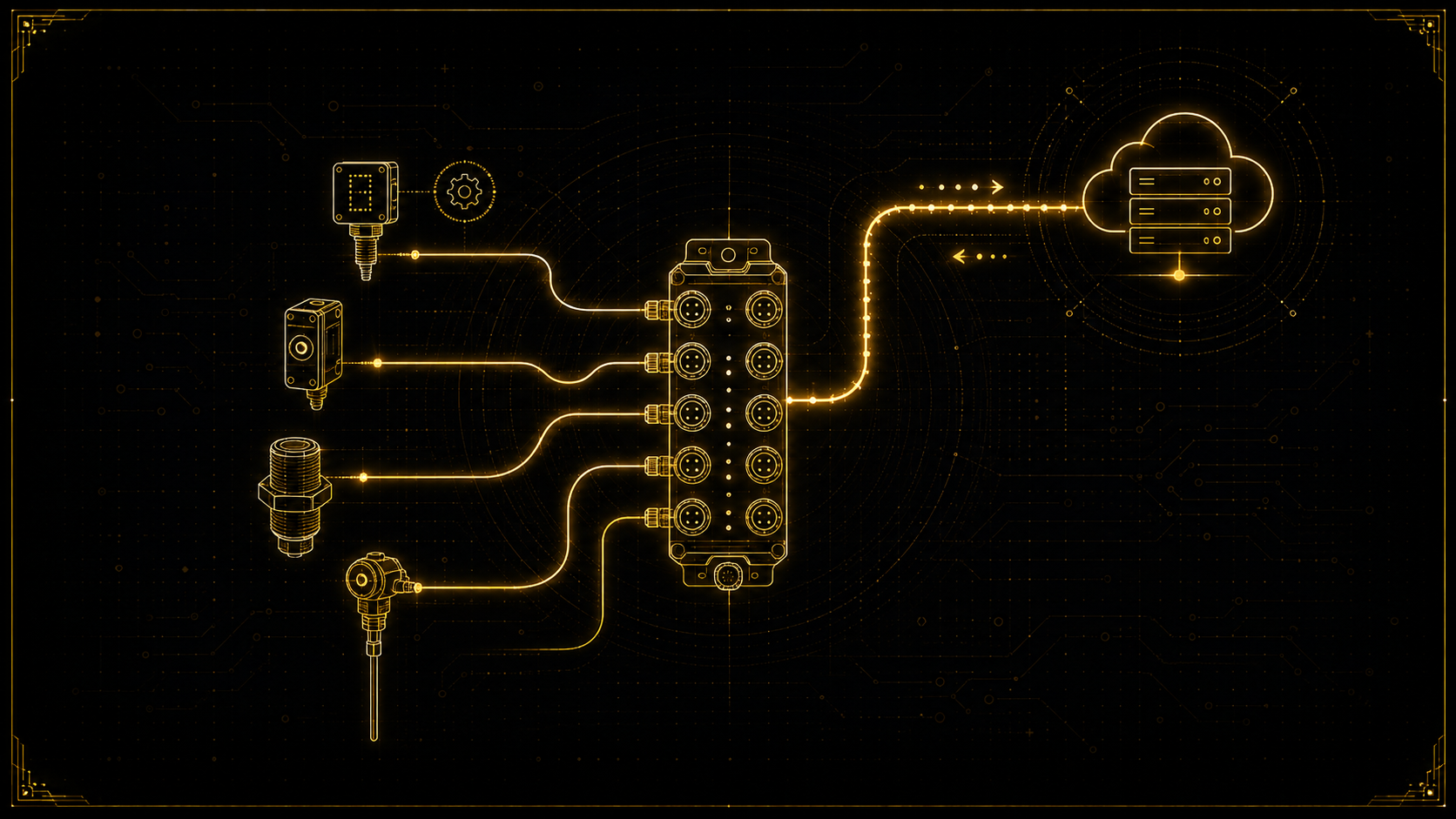
- Read the existing controller: if the machine has a PLC, its registers can often be read over Modbus, PROFIBUS or a serial port without altering the program.
- Tap digital signals: relay outputs, status lamps and dry contacts can be read directly to know run/stop, cycle complete or alarm states.
- Read analog signals: 4–20 mA loops and 0–10 V sensors give temperature, pressure, level and more.
- Add your own sensors: where the machine exposes nothing, a current clamp on a motor, a vibration sensor or an optical counter creates the data from the outside.
- Use a protocol gateway: a small embedded device translates the machine's old language (say Modbus RTU or PROFIBUS) into a modern one (MQTT or OPC UA) for your network.
- Unify with OPC UA: once several machines are connected, an OPC UA layer gives every system one consistent, secure way to access all of them.
A decision framework
Before choosing anything, answer these questions — they lead almost automatically to the right protocol:
- What interface does the machine already expose (if any)?
- How far is the data travelling, and through how much electrical noise?
- How fast and how often must the data update?
- Is real-time control required, or is monitoring enough?
- Is a cable feasible, or is wireless the only option?
- How will security and future expansion be handled?
Common pitfalls
- Choosing by fashion, not fit — the newest protocol is not always the right one for a 25-year-old machine.
- Ignoring electrical noise — a factory floor destroys weak signalling; robust physical layers matter.
- Leaving security for later — every connected machine must be secured from day one.
- No path to scale — a solution that works for one machine but cannot grow to fifty is a dead end.
Getting it right the first time
The difference between a smooth, reliable installation and months of troubleshooting is almost always the quality of these early decisions — the right physical layer, the right fieldbus, the right application protocol, and a realistic plan for the machine you actually have. That is exactly the kind of work I do: choosing and building the communication path that fits your equipment, your environment and your goals.
If you run a plant and need existing machines connected reliably — for monitoring, control, or full Industry 4.0 integration — contact me. Tell me what machines you have, and I will propose the right approach.